

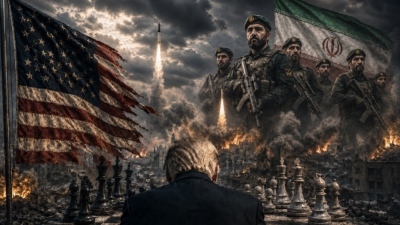
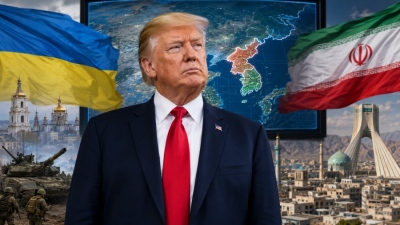
US President Donald Trump had stated that the war in Iran would end within a few weeks. Six months later, the conflict has turned into a nightmare for nearly everyone involved, directly or indirectly. When Trump launched the war against Iran, he characterized it as a "trip" that would last just a few weeks. Six months later, the reality has proven to be vastly different, CNN notes mockingly.
The conflict has proven catastrophic for the Iranian people, for millions living throughout the Middle East, and for consumers worldwide who are called to face an increased cost of living. At the same time, Trump's war goals remain unfulfilled, despite Washington's demands constantly shifting. Initially, he demanded the total surrender of Iran, regime change, and the abandonment of the Islamic Republic's nuclear ambitions. More recently, the objectives were narrowed down to the reopening of the Strait of Hormuz and the halting of Tehran's nuclear program.
The unexpected consequences of the war, however, have already surpassed the borders of the Middle East, affecting global security, harming international US prestige, and potentially offering Washington's adversaries an opportunity to expand their influence. As the Trump administration focuses almost all its energy on trying to disentangle itself from the crisis it created in Iran, it has turned its gaze away from other critical geopolitical fronts in which the US has long been involved: Ukraine, Taiwan, the South China Sea, and the Korean Peninsula. From Trump's decision to curtail annual joint military exercises with South Korea and withdraw the sole American aircraft carrier from the Western Pacific, to critical shortages of interceptor missiles in Ukraine, many of the most significant geopolitical and military consequences of the war may ultimately be felt far beyond the Middle East.
US adversaries are watching and taking notes
Emily Harding, vice president of the Defense and Security Department at the American think tank Center for Strategic and International Studies, assesses that while none of the potential flashpoints has yet escalated into a full-scale crisis, there are serious reasons for concern.
"This is a situation where the global adversaries of the US will be watching closely, learning more about how America reacts at critical moments, and then incorporating those conclusions into their planning. We haven't yet seen anyone exploit the situation, but that doesn't mean it can't happen," she noted. As she characteristically emphasized, "we do not yet see the building starting to shake, but its foundations are weakening."
Ukraine and Russia – The new crisis leaves Kyiv without weapons
The US-Israeli strikes provoked a fierce reaction from Tehran. Iranian drones, ballistic missiles, and other projectiles are hitting US bases and US allies across the entire Middle East. As the US and its allies consume their weapon stockpiles, part of the ammunition originally intended for Ukraine has been redirected to other fronts.
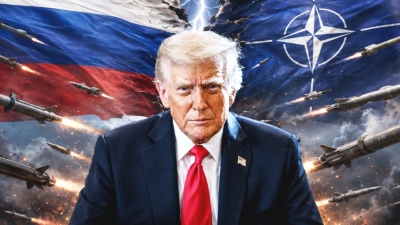
Ukrainian President Volodymyr Zelensky told CNN this month that his country possesses barely one-tenth of the interceptor missiles it urgently needs to counter growing Russian ballistic missile attacks. The shortages have catastrophic consequences for Ukrainians; this summer was the deadliest period for civilians since May 2022. At the same time, the global oil crisis caused by Iran's decision to effectively close the Strait of Hormuz has also undermined the Trump administration's economic pressure campaign against Moscow. Faced with rising gasoline prices in the US, Trump made the controversial decision to lift certain sanctions on Russian oil exports to relieve market pressure. In doing so, the US effectively helped Russia increase its revenues and further finance the war in Ukraine. The global disruption in the oil, natural gas, and fertilizer trade due to the closure of the Strait of Hormuz also helped Russia find new customers. Alexander Gabuev, director of the Carnegie Russia Eurasia Center in Berlin, mentioned that this was evident when Russian President Vladimir Putin hosted leaders of Southeast Asian countries in Kazan in June. "Participation in Kazan was impressive. Present were nine out of eleven ASEAN heads of state, along with the foreign minister of Indonesia and a special envoy from Myanmar. Above all, these leaders decided to make the long journey to Russia because of the US and Israeli strikes on Iran, which caused a spike in energy and fertilizer prices," he noted. From certain perspectives, the war in Iran has benefited Ukraine. The conflict made the rest of the world realize that more than four years of war have turned Kyiv into a drone superpower, leading to a series of defense cooperation agreements and commitments for ammunition supply from several countries.
The Korean Peninsula in the shadow of war
The war in Iran now casts its shadow over another potential flashpoint: the Korean Peninsula. North and South Korea have technically been at war for more than seven decades, as no peace treaty was signed following the 1950–1953 conflict. The US is deeply involved in the region, maintaining approximately 28,500 troops in South Korea. However, the long-standing relationship between the two countries faced a serious hurdle this year when Trump drastically reduced the annual joint military exercises Ulchi Freedom Shield with Seoul, citing in part South Korea's lack of support in the war against Iran. The American president has also left open the possibility of talks with North Korean leader Kim Jong Un, who is overseeing the continuous buildup of his country's nuclear arsenal and regular missile launches. Analysts point out that the reduction in military exercises impacts operational readiness in the short term in the event of a new war on the Korean Peninsula. On a more long-term level, it could delay the process by which Seoul assumes wartime operational control of its troops, something both South Korea and the US seek. South Korean officials stated this week that a second exercise focused on amphibious landings, scheduled for September, was canceled back in June. The exercises were supposed to involve US Marines stationed on the Japanese island of Okinawa, units of which had participated in the blockade of Iranian ports. Meanwhile, there is the critical issue of stockpiles and the supply chain. During the conflicts, a portion of American interceptor missiles was transferred from South Korea to the Middle East. The Pentagon has not disclosed how many missiles were relocated; however, analysts estimate that long-term shortages of critical defense systems, such as the Patriot, are likely.
Taiwan and the South China Sea – The US without an aircraft carrier in the Pacific
The deployment of the aircraft carrier USS George Washington, based in Japan, to the Arabian Sea to replace the hard-pressed USS Abraham Lincoln leaves the US without any aircraft carrier in the Pacific for an unspecified period. The US had maintained a continuous aircraft carrier presence in the Pacific for over two decades, with the sole exception of a few weeks' gap in 2024. The absence of an aircraft carrier from the US 7th Fleet's area of responsibility raises serious questions for Washington's regional allies. The Philippines is expected to be particularly concerned due to increasing Chinese activity in the South China Sea and around disputed areas such as Scarborough Shoal, which lies within the Philippines' exclusive economic zone but is effectively under Beijing's control. Tensions between Manila and Beijing are also expanding around Second Thomas Shoal, also located in the Spratly Islands. In both areas, maritime confrontations have occurred between Philippine and Chinese personnel. The US and the Philippines are bound by a mutual defense treaty. If tension with China escalates, the absence of an aircraft carrier from the region could put American forces in a particularly difficult position, especially given the already severe issues with ammunition stockpiles. Emily Harding expressed particular concern over the situation the US would find itself in during a potential conflict with China. "The major issue that worries me is the situation the US would face in a potential conflict with China. We don't see something like that happening immediately. However, if there were a conflict with China, we would be in a state of ammunition shortages, especially of those we would need in such a war," she stated.
Global maritime choke points on the war's new front
The war could have other disastrous consequences if other players decide to weaponize additional critical international maritime passages. "We aren't seeing it yet, but if in the future one of these countries decided to do so, it could cite this situation as a precedent," Harding noted. As she added, the intensity of the war's impact will primarily depend on how long the US continues to fight. "The Trump administration must decide what outcome it considers good enough. If the only acceptable solution is the complete destruction of the nuclear program and what Israel desires—namely, an internally shattered and divided Iran—then this is a long-term commitment in blood and money, and the global economy will feel the consequences for a long time," she stated. Trump could, however, decide that rendering Iran's nuclear program "non-functional" is sufficient. Such an outcome, as he has implied, could be achieved by keeping critical facilities—currently destroyed and buried under rubble—inaccessible to Iran, striking them whenever Tehran attempts to regain access. "It is not the ideal solution, but it is a workable solution. If that is enough, and if weakening the network of Iranian proxies is enough, then the main remaining issue is the Strait of Hormuz. This is difficult and costly, but it doesn't cost anywhere near what the US is doing today," she noted. From the Iranian perspective, the objective is much simpler. "All they have to do is survive—and they are doing it. Therefore, they can maintain this situation for as long as they want."
www.bankingnews.gr





Σχόλια αναγνωστών